
Showing posts with label India. Show all posts
Showing posts with label India. Show all posts

India : last photos
Click on the image below to see some photos taken in Rajasthan, Gujarat and again in Mumbai :
 |
| India - Rajasthan, Ahmedabad, Mumbai |
India : We are hooked !
After only 10 days in India, we felt like we had been for ages in the country. We actually had some hard time understanding the people who chooses to travel around it for months or even years. But as the weeks went by, we have become to enjoy this complex country more and more and, now that the time to leave it has come, we have to admit that we'd have loved our stay to be longer than 43 days.
From Amritsar, we headed for Rajasthan, a State that stretches across an arid land and is scattered with impressive fortified palaces. The forts were built to resist all kind of hurdles by lineages of Maharajas that, as any feudal lord worth its name, spent their time fighting and planning marriages among them and with the Mughals. When the English took over the declining Mughol empire, they still managed to kept their luxurious way of life well into the 20th century, which I guess is why the palaces are rather well preserved.

Seen from outside, the forts look sober and massive. But once inside the city walls you find yourself wandering around intricate streets, small squares and palaces filled with courtyards, corridors, blind windows from where women could see without being seen, Turkish baths and richly carved walls that conjure up images from the Book of One Thousand and One Nights.
The towns that surround the palaces have each a predominant colour that confers it a certain harmony : pink in Jaipur, blue in Jodhpur or white in Udaipur. But the one I liked the most was Jaisalmer, where the stone facades are so finely carved that they look like wood, and the yellowish sandstone buildings blurs into the surrounding desert.

While touring the area, we visited a few 19th century Havelis (traditional mansions) where the period furniture and interior decoration shows the penchant for psychedelic ornamentation of their wealthy owners, we loafed around bazaars and went to a couple traditional puppet and dance shows. We discovered also the importance that turbans and distinguished-looking mustaches had in the region : the color, length and the way the former is knotted, as well the shape of the latter, indicate the social status, the occupation and even the religion of the bearer. In the same way, the colors of the sari a woman wears will depend on the season and her civil status.
Before going back to Mumbai, and with the thermometer rising over the 40° mark(although it is not until may-june that the temperatures go completely loony), we did a last stop in the capital of Gujarat State, Ahmedabad. Even if it is mainly an industrial city, it has got an amazing collection of old Indian textiles worth the visit, an interesting guided tour of the historical center and the Ashram (retreat) that was Gandhi's headquarters for a period of his life.

But the highlight of our visit to this town laid in the lovely family that hosted us via couchsurfing. Staying with Rushir gave us the chance to share a few days with a typical Indian family, in which wedded couples settle with the husband's parents. All of them went out of their way to make our visit enjoyable, to the point of taking us along to an wedding dressed with clothes they lent us. We even got a ride in a sidecar, driven skillfully by the senior lady of the house. A true immersion in the great Indian hospitality.
A couple of additional days visiting Mumbai and staying wagain at Louella's and we have to say goodbye to this country. We hope to comeback sometime in future because we have left so much unvisited. And this time, we will come with empty suitcases so I can strip bare bazaars at ease. For now, we continue our route, heading back to Southeast Asia, and more in particular, for Thailand.
Bea
From Amritsar, we headed for Rajasthan, a State that stretches across an arid land and is scattered with impressive fortified palaces. The forts were built to resist all kind of hurdles by lineages of Maharajas that, as any feudal lord worth its name, spent their time fighting and planning marriages among them and with the Mughals. When the English took over the declining Mughol empire, they still managed to kept their luxurious way of life well into the 20th century, which I guess is why the palaces are rather well preserved.
Seen from outside, the forts look sober and massive. But once inside the city walls you find yourself wandering around intricate streets, small squares and palaces filled with courtyards, corridors, blind windows from where women could see without being seen, Turkish baths and richly carved walls that conjure up images from the Book of One Thousand and One Nights.
The towns that surround the palaces have each a predominant colour that confers it a certain harmony : pink in Jaipur, blue in Jodhpur or white in Udaipur. But the one I liked the most was Jaisalmer, where the stone facades are so finely carved that they look like wood, and the yellowish sandstone buildings blurs into the surrounding desert.
While touring the area, we visited a few 19th century Havelis (traditional mansions) where the period furniture and interior decoration shows the penchant for psychedelic ornamentation of their wealthy owners, we loafed around bazaars and went to a couple traditional puppet and dance shows. We discovered also the importance that turbans and distinguished-looking mustaches had in the region : the color, length and the way the former is knotted, as well the shape of the latter, indicate the social status, the occupation and even the religion of the bearer. In the same way, the colors of the sari a woman wears will depend on the season and her civil status.
Before going back to Mumbai, and with the thermometer rising over the 40° mark(although it is not until may-june that the temperatures go completely loony), we did a last stop in the capital of Gujarat State, Ahmedabad. Even if it is mainly an industrial city, it has got an amazing collection of old Indian textiles worth the visit, an interesting guided tour of the historical center and the Ashram (retreat) that was Gandhi's headquarters for a period of his life.
But the highlight of our visit to this town laid in the lovely family that hosted us via couchsurfing. Staying with Rushir gave us the chance to share a few days with a typical Indian family, in which wedded couples settle with the husband's parents. All of them went out of their way to make our visit enjoyable, to the point of taking us along to an wedding dressed with clothes they lent us. We even got a ride in a sidecar, driven skillfully by the senior lady of the house. A true immersion in the great Indian hospitality.
A couple of additional days visiting Mumbai and staying wagain at Louella's and we have to say goodbye to this country. We hope to comeback sometime in future because we have left so much unvisited. And this time, we will come with empty suitcases so I can strip bare bazaars at ease. For now, we continue our route, heading back to Southeast Asia, and more in particular, for Thailand.
Bea
Photos : Agra, Delhi, Amritsar
Click on the photo below to view some of the pictures we took while traveling from Agra up to the Pakistani border :
 |
| India - Agra, Delhi, Amritsar |
We almost made it to Pakistan
After leaving Khajuraho and a short night train ride, we landed in Agra. This city is quite a milestone in our trip across North India since it is home to the famous Taj Mahal. To enjoy this world class monument before the crowd hits it, we were queuing at the entrance at dawn, which spared us as well the massive heat that starts pounding after 10 am. It was really worth it to be there so early to enjoy the monument at first day light.

On the first two weeks, we have been mainly in important Hinduism areas. Agra and its surroundings gave us a glimpse on the Muslim India and the heritage left by the mughals when ruling the region. Today, 15% of the Indians are Muslim and 80% are Hindu. Even the Islam here seems to have a masala flavour : some of the rituals reminded more what we saw in the Hindu temples than what is done in Morocco, for example.
New Delhi, our next stop, has also many buildings of that era, like the Red Fort and Humayun's Tomb. At our arrival in the country's capital, we shared our breakfast table with a farmer and his two kids that managed with that to accomplish two dreams in one day : ride the subway and meet a foreigner. On our two first weeks in India, the constant touts attention made us switch the paranoid mode on. But little by little, we have also met some genuinely nice and welcoming people that on a train will share their meal with you without any hesitation. I am very often mistaken for an Indian and sometimes I will be addressed in Hindi or even in some local languages like Maharati or Punjabi. Once, when I insisted that I am from a Moroccan origin, I got in return : “ Are you parents Indian immigrants ?”
Even if Delhi was less impressive than Varanasi, we enjoyed this city that offers landmarks from the Mughal era to British colonization times. As in the rest of the country, we noticed in this city some interesting contrasts : busy western fast foods and upscale brand shops versus the traditional bazaars and the ear cleaner doing business as usual with some scary tools.

Even if our veg diet is still on, we took a break to taste the dish of one of my homonyms that is city wide known. His restaurant is serving Mughal cuisine that his forefathers were already cooking for the emperors. “Karim's” is quite famous and a lot of people comes to eat the whole stuffed and roasted goat. As we should have ordered this delicacy 24 hours in advance, we treated ourselves to some chicken and lamb kebab Burrah style (marinated and barbecued). It is was so good that I need to finish this paragraph quickly as my mouth is watering way to much. Looking forward for the next eid-el-kebir.
After Delhi, the train took us to Amritsar, Sikhism holiest city. Even if the Sikhs represent less than 2% of the population, there are very visible thanks to their turban and a solid physical build. We were impressed by the golden temple that sits in the middle of a sacred pond and the 750 Kg that cover its top. Even the fans inside are gold-platted. There is also a kitchen that serves for free more than 60 000 meals daily to the pilgrim that comes from all around the world. It is truly a city within the city.

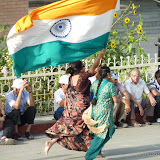
The other highlight when you visit Amritsar is actually Pakistan. Every day, a very popular border closing ceremony is held by both sides. It is an odd mix of : Military and patriotic songs, kids and ladies dancing on “slum-dog millionaire” music, soldiers taking provocative stands towards the neighboring country and nationalist slogans shouted from each side of the border. There is even a guy whose job is to encourage the audience to shout more and louder than Pakistanis that are asked to do the same against the Indians.
As foreign spectators, during the first minutes of the show, we laughed a bit before remembering the 2008 Mumbai bombings and all the negative comments about Pakistan we heard during this trip. Between these two nuclear super powers, wars have been fought leaving behind thousand of casualties. On the way back, we were wandering how an official ceremony promoting hate toward a neighboring country could be hold on Ghandi's home land.
Karim
On the first two weeks, we have been mainly in important Hinduism areas. Agra and its surroundings gave us a glimpse on the Muslim India and the heritage left by the mughals when ruling the region. Today, 15% of the Indians are Muslim and 80% are Hindu. Even the Islam here seems to have a masala flavour : some of the rituals reminded more what we saw in the Hindu temples than what is done in Morocco, for example.
New Delhi, our next stop, has also many buildings of that era, like the Red Fort and Humayun's Tomb. At our arrival in the country's capital, we shared our breakfast table with a farmer and his two kids that managed with that to accomplish two dreams in one day : ride the subway and meet a foreigner. On our two first weeks in India, the constant touts attention made us switch the paranoid mode on. But little by little, we have also met some genuinely nice and welcoming people that on a train will share their meal with you without any hesitation. I am very often mistaken for an Indian and sometimes I will be addressed in Hindi or even in some local languages like Maharati or Punjabi. Once, when I insisted that I am from a Moroccan origin, I got in return : “ Are you parents Indian immigrants ?”
Even if Delhi was less impressive than Varanasi, we enjoyed this city that offers landmarks from the Mughal era to British colonization times. As in the rest of the country, we noticed in this city some interesting contrasts : busy western fast foods and upscale brand shops versus the traditional bazaars and the ear cleaner doing business as usual with some scary tools.
Even if our veg diet is still on, we took a break to taste the dish of one of my homonyms that is city wide known. His restaurant is serving Mughal cuisine that his forefathers were already cooking for the emperors. “Karim's” is quite famous and a lot of people comes to eat the whole stuffed and roasted goat. As we should have ordered this delicacy 24 hours in advance, we treated ourselves to some chicken and lamb kebab Burrah style (marinated and barbecued). It is was so good that I need to finish this paragraph quickly as my mouth is watering way to much. Looking forward for the next eid-el-kebir.
After Delhi, the train took us to Amritsar, Sikhism holiest city. Even if the Sikhs represent less than 2% of the population, there are very visible thanks to their turban and a solid physical build. We were impressed by the golden temple that sits in the middle of a sacred pond and the 750 Kg that cover its top. Even the fans inside are gold-platted. There is also a kitchen that serves for free more than 60 000 meals daily to the pilgrim that comes from all around the world. It is truly a city within the city.
The other highlight when you visit Amritsar is actually Pakistan. Every day, a very popular border closing ceremony is held by both sides. It is an odd mix of : Military and patriotic songs, kids and ladies dancing on “slum-dog millionaire” music, soldiers taking provocative stands towards the neighboring country and nationalist slogans shouted from each side of the border. There is even a guy whose job is to encourage the audience to shout more and louder than Pakistanis that are asked to do the same against the Indians.
As foreign spectators, during the first minutes of the show, we laughed a bit before remembering the 2008 Mumbai bombings and all the negative comments about Pakistan we heard during this trip. Between these two nuclear super powers, wars have been fought leaving behind thousand of casualties. On the way back, we were wandering how an official ceremony promoting hate toward a neighboring country could be hold on Ghandi's home land.
Karim
Photos : Mumbai, Varanasi, Tala, Khajuraho
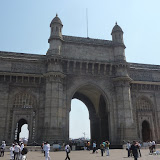
Click on the following picture to have a look at some photos taken during the first leg of our Indian visit :
 |
| India - Mumbai, Varanasi, Tala, Khajuraho |
More about India : elusive tigers and Kamasutra
To reach our next destination we jumped on a train, where we found out that Indian people are as tolerant with cockroaches as they are with cows. Hordes of them moved up and down the wagons freely and unscathed under the indifference of our fellow travellers. After getting rid of a few of them we realised the futility of the task and we decided to apply the maxim 'When in Rome, do as Romans do'. After this trip we will have seen it all before : it is not the sight of a rat or cockroaches coming out from the shop where we just bought a packet of biscuits that will make us shudder. As for mosquito-eating geckos, they have become our best friends. As we say in Spain “what does not kill you makes you stronger”.

Since our arrival we have been following mainly a vegetarian diet, partly because restaurants serving meat are scarce, and partly because it is the best way to avoid the Delhi belly. However, Indian vegetarian food is so tasty and varied that finally we do not miss that much the meat. The tea is another treat, it is served with milk and flavoured with different spices and sugar.
The train left us close to Bandhavgarh National Park. As per Lonely Planet, it is one of the places in India where you have most chances to see a tiger in its natural habitat. If you get really lucky, you can even spot a leopard. But in our case, we scored a big zero in cats, even after two safaris. The only thing we saw were a few footprints and, according to our guide, we heard the distress warning call made by a deer when looking a leopard at close range. Luckily, there were plenty of other animals to liven up things : wild boars, foxes, peacocks and even plenty of Bambis. The long drives by jeep also gave us time to meet and discuss with Franck and Marie, a very nice couple from South France who have been working for years for a humanitarian NGO, but that are currently taking a few months off to travel around Asia. It was really interesting to learn from their organisation from somebody involved in field-work.

This leads to mention the hardest aspects of traveling in India, that will shock you even if you have prepared mentally for it : the extreme poverty of an important part of the population and the general lack of cleanliness. It is crazy to think that a country that has got the money and the technology to send missions to the moon and that has produced 3 of the 5 biggest fortunes in the world can keep such levels of misery. If Gandhi is looking at his country from the hereafter, it must really be difficult for him to rest in peace.
Next stop : Khajuraho, known by its spectacular 10th century temples finely engraved, among others, with erotic Kamasutra figures. Everywhere in India you have to put up with touts that lie in wait of potential customers and that prevent you from visiting peacefully. But in this particular town, there are so many and they are so insistent that it is a real nightmare : even Karim, that grew in Morocco and is supposed to be vaccinated against them, lost his calm. But the saddest thing of all is that most children here will approach you to ask you for 'chocolate', 'school pen' and 'rupies'. Even when the mother is present she will not say anything. If I had dared do the same as a kid, my bottom would still be hurting from my the spanking I would have received.

We leave this town with mixed feelings and we head for the Mecca of Indian tourism : Agra and the famous Taj Mahal.
Bea
Plunging in India, but not in the Ganges.
What a crazy place is India ! We spent our first days in the country with Louella, our lovely couchsurfing host, thanks to whom we have enjoyed a few quite bucolic days in Mumbai (Bombay). Hosting is an art in India : not only did she made us feel at home, but she did not leave for work until she made sure we were properly established at her place and acquainted with Mumbai's public transport system. She also asked a friend to come fetch us at dawn the next day to take us to the city's National Park where there are Budist caves dating from the 10th century carved in the stone. Even her mother, who leaves in the neighbourhood, asked us to come meet her and have breakfast a second time, just in case her daughter had not fed us well enough.

After a couple of days in such a great company, we took a flight to Varanasi (ex-Benares), which is one of the oldest towns in the World, as well as a very important sacred destination for Hindus. Mumbai is bursting with people and the crowds trying to catch the suburban train at rush hour any given day are worse than those on a public transport strike day in Madrid or Paris. However, it still feels relaxed compared to Varanasi. Definitely, the vision of India we had built in our heads, based on our readings and what we had been told by other travellers, felt short of the reality we met at our arrival into this picturesque city.
Narrow and labyrinthine medieval streets are carpeted with cow droppings and other dirt (if it is true that stepping on pooh ensures luck, then we must have cumulated enough for our next three lives, as our hotel was in a badly lighted lane). Monkeys reign on rooftops while cows walk freely in the streets, eating whatever they find. And indeed there are quite a lot of stables built directly inside the city limits. For example, in our favourite restaurant, clean and hygienic as few, located in a beautiful patio with a temple, if you walk just a few steps up to the temple you will discover that a wall separates it from a cow shed.

In the few wider streets, there is a thick and non-stop traffic of rickshaws, bicycles, motorcycles, cars, seller stalls and people dodging each other in a chaotic way and using freely their oversized horn. Quite often a cow decides to have a rest in the middle of the street complicating furthermore the traffic. And cows here are so stolid ! I must admit that coming from Spain I am quite distrustful of them. Indeed, I never thought I would ever in my life dare to get this close to a bull horns as I have here, but since cattle here is so calm and docile it is hardly something one can boast about.
Then, there are the Ganges banks, some hosting burning piers, others piles of laundry being washed and dried, or yet others believers and buffalos bathing and purifying in a water not precisely known for its purity level (I would probably disintegrate if I dared to go in there). Goats go up and down the ghats looking for a shadowed corner or sneaking to steal the death's flower collars. Walking in town you cross a colourful mix made of pilgrims with their heads shaved (both men and women) walking in line, funeral processions, women in sari, men in kurta/dothi, meditating hermits (some with their long hair dressed around the head like a turban), people wearing western style clothes and even a few women in burqa. But the most shocking individual was the hard-core ascetic that we saw going around town as naked as the day he was born.

What we have seen (or rather, what blew our minds) in this first week in India, is enough to write a thousand posts since, as the add says, this is really an Incredible country.
Bea
After a couple of days in such a great company, we took a flight to Varanasi (ex-Benares), which is one of the oldest towns in the World, as well as a very important sacred destination for Hindus. Mumbai is bursting with people and the crowds trying to catch the suburban train at rush hour any given day are worse than those on a public transport strike day in Madrid or Paris. However, it still feels relaxed compared to Varanasi. Definitely, the vision of India we had built in our heads, based on our readings and what we had been told by other travellers, felt short of the reality we met at our arrival into this picturesque city.
Narrow and labyrinthine medieval streets are carpeted with cow droppings and other dirt (if it is true that stepping on pooh ensures luck, then we must have cumulated enough for our next three lives, as our hotel was in a badly lighted lane). Monkeys reign on rooftops while cows walk freely in the streets, eating whatever they find. And indeed there are quite a lot of stables built directly inside the city limits. For example, in our favourite restaurant, clean and hygienic as few, located in a beautiful patio with a temple, if you walk just a few steps up to the temple you will discover that a wall separates it from a cow shed.
In the few wider streets, there is a thick and non-stop traffic of rickshaws, bicycles, motorcycles, cars, seller stalls and people dodging each other in a chaotic way and using freely their oversized horn. Quite often a cow decides to have a rest in the middle of the street complicating furthermore the traffic. And cows here are so stolid ! I must admit that coming from Spain I am quite distrustful of them. Indeed, I never thought I would ever in my life dare to get this close to a bull horns as I have here, but since cattle here is so calm and docile it is hardly something one can boast about.
Then, there are the Ganges banks, some hosting burning piers, others piles of laundry being washed and dried, or yet others believers and buffalos bathing and purifying in a water not precisely known for its purity level (I would probably disintegrate if I dared to go in there). Goats go up and down the ghats looking for a shadowed corner or sneaking to steal the death's flower collars. Walking in town you cross a colourful mix made of pilgrims with their heads shaved (both men and women) walking in line, funeral processions, women in sari, men in kurta/dothi, meditating hermits (some with their long hair dressed around the head like a turban), people wearing western style clothes and even a few women in burqa. But the most shocking individual was the hard-core ascetic that we saw going around town as naked as the day he was born.
What we have seen (or rather, what blew our minds) in this first week in India, is enough to write a thousand posts since, as the add says, this is really an Incredible country.
Bea


